SEO Tips
I have to admit it – I failed this 30-day blogging challenge. I couldn’t keep it consistent and write one blog post every single day. There were other things I had to do, but hey, I am not gonna lie here. I want to be completely transparent and keep myself accountable. After my regular work hours, I just came home, spent some time with the kids, did some work on my clients, and then watched YouTube till I was falling asleep.
Nevertheless, I am not giving up, and I continue the series as I am sitting in front of Temple Street Eatery cafe waiting for it to open. You lose only when you give up doing something and I don’t plan to give up posting. I have 26 blog posts to go to see what will happen to my website.
And by the way, I have something interesting to share with you:
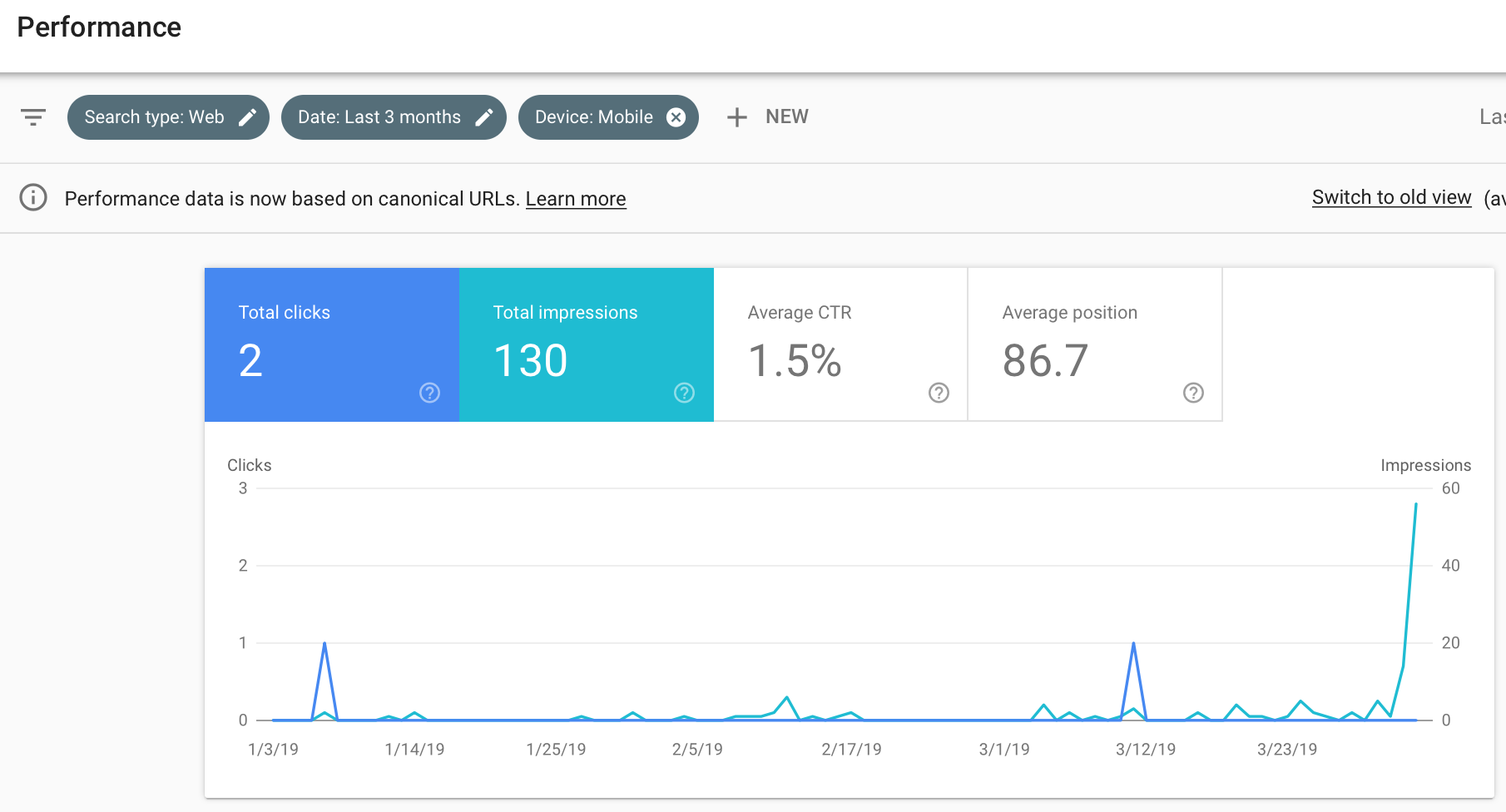
On the graph above you can see that there a huge spike in Impressions that has just taken place in Google Search Console. What are the Impressions according to Google?
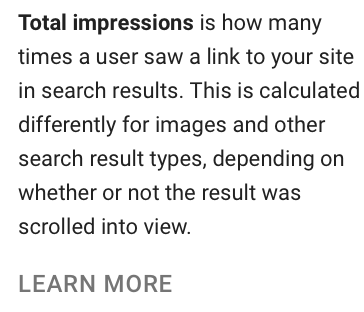
So here is what I think has happened.
Let’s look at the crawl results:
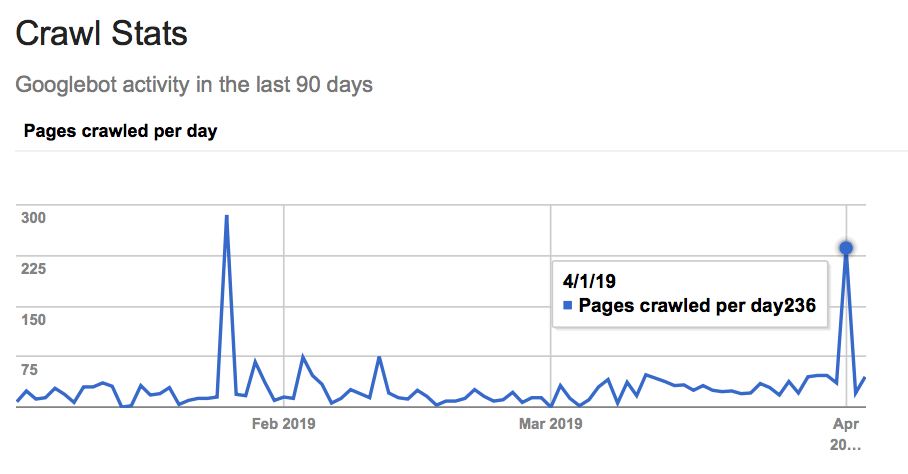
As you can see, Googlebot was crawling my website at its regular pace. Then on April 1st, there was I huge spike in pages crawled because I started posting at a much higher frequency than Googlebot used to see on my website. This resulted in a signal from Googlebot to Google to pay more attention to my website and push more pages into Google index. The spike in pages crawled happened on April 1st, and the spike in total impressions took place on the next day, April 2nd.
Another thing I’ve noticed is that there are more keywords in the search results right now that my website shows up for (233 keywords total) than it used to be.
So are you up for a challenge? Here is some information. In short: I encourage you to write and post one article on your website every day for 30 days straight on the topic of your expertise. There are multiple benefits to doing that. Read more about it in the original post. Additionally, amplify the content you create by sharing it on social networks with hashtag #30dayblogchallenge. If you support this idea feel free to get in touch with me on Instagram and on Twitter.
What would you like me to write the next post about? Please, let me know.
I have a few options I am considering:
- Books on Marketing and Business I’ve read and recommend
- What is Artificial Intelligence, my experience working with it and how I apply it in SEO today
- …. (please add your topics, topics that are interesting to you)
What is the modern marketer? What does this mean?
- The Modern Marketer should be reading a lot.
The reason is the world around us is developing so fast right now. In order to keep up to speed and to remain competitive in your niche, you need to read books.
There are so many interesting books on marketing that get published every month. For example, the one I’ve been reading these days is Digital Relevance. Despite being written for B2B there are still many things in the book that can be applied to B2C segment.
The book was published first in 2015 but I just recently discovered this gem. If only I could get my hands on it in 2015! I can only imagine what competitive advantage it would give me back then…
A few other books on marketing and advertising I recommend when somebody asks me about the best ways to generate leads:
- Traction: How Any Startup Can Achieve Explosive Customer Growth
- One Page Marketing Plan
- Getting Everything You Can Out of All You’ve Got
I’ve read these 3 books above. They are highly actionable. Read them.
2. The Modern Marketer should never stop learning.
In 2015 I learned about RankBrain algorithm that Google created to rank websites. Immediately I started thinking about what could I do to keep the competitive edge on SEO. That led me to this course on Machine Learning on Udacity. I took this course and learned how to build machine learning models. I applied the lessons learned to a dataset of Google search results (700 search results for the keyword “property management software”) to see if there are any ranking factors influencing the position of a web page.
You should also attend conferences. I try to go to at least one conference on marketing every year, no matter what. Here is a funny store: I attended my first conference on SEO, SMX West in San Jose, CA in 2012. There was Bruce Clay’s one-day SEO workshop that I took. After the workshop, I realized I hadn’t known SEO at all! (keep in mind, I had been doing SEO for a few years by that date). The conference that I like to attend on marketing is called Traffic and Conversion Summit, and it is organized in San Diego every year by Digital Marketer. Another conference I attended recently is 10X Growth Con in Miami. As you can see, this series of 30 posts is the result of the “Massive Action, 10X approach” I learned from Grant Cardone.
3. The Modern Marketer should be looking for opportunities everywhere around them and compare the things that are uncomparable.
Last year Gartner published their annual report on contemporary trends. Besides many other trends in it Digital Twin technology was something that captured my attention. The Digital Twin technology is about creating a virtual copy of a physical device by using sensors. This method allows you to track the physical device in real time by analyzing the virtual copy. You could also conduct the experiments on the virtual copy without touching the physical device. I asked myself: is it possible to apply this technology to SEO? For example, how about creating a digital twin of a web page? What are the benefits of such an approach?
As a marketer, should you be studying selling? I think it’s absolutely yes. I got myself a course on selling from Grant Cardone, that I listen 2-3 times per week. Will it make me a better marketer? Yes, because the sales team and the marketing team complement each other. In order to understand the sales processes, you need to understand the principles of selling.
What about studying other marketing channels? My answer is yes, but here is a catch: I suggest specializing in a particular marketing channel and learning a bit about other channels as well. For example, if you specialize in SEO it will never hurt to create your own email list and do email marketing using Mailchimp or Aweber, start a YouTube channel, or launch a podcast.
4. The Modern Marketer should always be constantly asking themselves “What’s next?”
I normally ask myself this question a few times per year. I think it’s a good habit to develop to think about what’s coming next in marketing. Will it be agumented reality used by everyone? How about voice search? You most likely have heard about Google Galss or Microsoft Hololens. These technologies are coming. If all goes well in a few years we should experience a significant leap in technologies. Self-driving cars with voice commands and smart homes with access to Internet and directly to Google. Robotic assistants using knowledge graphs. Many technologies that are being developed in separate silos will soon be converged into some helpful solutions that would be used by millions. When that happens, will you be ready? Do you have the plan for your organization in place to account for these changes?
5. The Modern Marketer should be actively networking.
The ability to make friends with people should become the second nature of any marketer who wants to become highly successful. Every marketer should understand NLP (Neuro Linguistic Programming) and be able to recognize it and use it when needed. Be present on LinkedIn and on other social networks. Be helpful to people and provide value upfront. Be willing to share the knowledge that you’ve learned.
Good luck!
This blog post in #4 in the series of 30 blog posts called “30-Day Blog Post Challenge”. Check my first blog in the series here. In short: I encourage you to write and post one article on your website every day for 30 days straight on the subject that you like. There are multiple benefits to doing that. Read more about it in the original post. Additionally, amplify the content you create by sharing it on social networks with hashtag #30dayblogchallenge. If you support this idea feel free to get in touch with me on Instagram and on Twitter.
Also, let me know if you would like me to cover any particular topics related to business/marketing.
#30dayblogpostchallenge
After I published my last post yesterday I got a commentary on Facebook from an old friend of mine asking to write about lead generation.
I cannot say that I am an expert in lead generation (there are people who specialize in lead gen and this is what brings food on their table). I’ve always focused mostly on driving organic traffic to my clients’ sites. However, there is something that I know about lead generation and this is something I would like to share with you.
My first true exposure to lead generation happened when I got hired as an SEO Specialist by a lead generation company. It was back in 2011 and I didn’t know much about lead generation back then. My task was to optimize a number of financial websites that the company maintained. There were two problems with these websites:
- They were built on a custom CMS.
- There were a few hundred of them and all of them had the same layout and were pretty shallow on content.
I had to do something to rank these sites organically. Obviously, these websites did not present any value to consumers from the SEO standpoint. There was no helpful content on them at all. Google didn’t rank them well. Also, the company was running an affiliate marketing program and had hundreds of affiliates all over the world who did everything they could (everything you can imagine) to generate leads to these sites using their unique affiliate ids. That added complexity to SEO work because I could not control the links that affiliates generated to these sites.
We did a couple of experiments back then related to lead generation.
Experiment 1: On one of our major websites we had a rotating slider at the top. We used Google Optimizer to run an A/B test experiment to see which image would have the highest lead conversion rates. It turned out that a certain static image outperformed the rotating sequence version and other static images.
Experiment 2: We used a custom framework and about 20 domains with a combination of auto-generated and duplicate content on certain topics. These sites got banned by Google in 2 weeks or so.
I remember that trying to solve this issue I attended my first SMX West conference on SEO in San Jose and asked Chris Boggs from Rosetta during an open table session what to do with these websites, how do I rank them at all? I remember that Chris recommended me to find any differences or prominent features on these sites and attempt to focus on them. That was pretty hard to do because these websites were all the same, just the colors and the main pages were different. So I failed to rank organically the websites in financial vertical that the company had.
I came back from the conference and told our CEO about the SEO methods that I learned during the conference. They listened to me and gave me another site to rank, InsuranceFiles.com. The purpose of that site was to generate leads by attracting insurance agents who’d need to buy insurance leads.
With this one good website instead of hundreds of low-quality sites, I had much more options. I had an opportunity to build it from scratch, and this is exactly what my team did. After interviewing a few web design companies we posted a web design project on CrowdSpring (or maybe it was some other website based on the same model). After selecting the winner whose design we all liked we sent that PSD file to a company that converted PSDs to WordPress.
Now I had a live website built on WordPress that with a nice design that Google would like. Then I optimized this website by outlining the content structure and posting content strategically. The idea was to have content silos. For example, we picked a certain topic within the overall theme of the website. I then asked a content writer to create content on five subtopics related to the main topic. So I got 6 pages of content – one main one, about the topic and 5 supporting pages. I then interlinked these 5 pages with one another and also each of these 5 supporting pages was linking back to their main parent page. This method worked exceptionally well and we started ranking in Top 10 Google for many related keywords.
Other than my personal lead generation experience I’ve also worked as a consultant with other people who ran lead gen websites in different niches. For example, a friend of mine used to own a few domains in landscaping niche. The domain names he purchased would look something like this: landscapingdallastx.com. He would then use a WordPress theme tailored for lead generation and also purchased phone numbers related to the area of service. Then he would call local contractors in that area and offer them to work with him. The contractor that agreed to work with him would get the leads redirected to their phone number from the phone number that my friend purchased.
Leads are generated from traffic that comes to your website or another web asset that you own (a Facebook page for example). Therefore the question becomes: “How do I get targeted traffic to my website?”. There is a number of ways to do that. I always like to recommend a book called “Traction: How Any Startup Can Achieve Explosive Customer Growth” This book contains a number of proven ways to do that.
This blog post in #3 in the series of 30 blog posts called “30-Day Blog Post Challenge”. Check my first blog in the series here. In short: I encourage you to write and post one article on your website every day for 30 days straight on the topic of your expertise. There are multiple benefits to doing that. Read more about it in the original post. Additionally, amplify the content you create by sharing it on social networks with hashtag #30dayblogchallenge. If you support this idea feel free to get in touch with me on Instagram and on Twitter.
Also, let me know if you would like me to cover any particular topics related to business/marketing.
#30dayblogpostchallenge
This is the continuation of the 30-day blogging challenge. (You can read part one describing the rules here) Today, we gonna be talking about your customer, customer experience, and how to earn the trust of your customer.
Focusing on your customer should be the top priority for any business.
When I started Athena SEO my goal was to get as many customers as possible and provide the SEO services to them. I knew very little about the way you should treat your customers. The key component to your relations to your customers is attention.
Why attention? Because when someone reaches out to you and tells you that someone recommended them to you, you already have some credit and trust. But then it’s up to you, whether you’ll be able to maintain that trust or you lose it.
What does it mean to maintain trust? There are a couple of things I learned along the way that I would like to share with you, that are related to customer service and attention to your customers.
- One thing I did right since I started my SEO career was sending weekly reports to my clients every Friday, no matter what. I did that consistently since around 2009 to around 2015 and I believe that’s the absolutely right thing to do and a great weapon in your arsenal to earn and maintain your customers’ trust and attention. (I’ve switched from every Friday’s reports to a random format due to changes in the nature of SEO work I am doing these days, more on that later)
- Another thing I learned from Andy Frisella during the first 10X Growth Con is that you need to satisfy every need of your clients (or potential clients). Andy gave an example of a lady who came to their store by occasion and asked if the store assistant could help her change the battery in her car. Despite the fact that Andy’s store had nothing to do with cars, the store assistant gladly helped that lady and that resulted in great customer experience.
- You need to answer any comments and any reviews to your business and products. It’s especially important with negative reviews. A good social marketing manager or a business owner should be jumping right in and figure out what’s going on and how to fix/improve customer experience. Grant Cardone even suggests turning negative reviews into potential sales opportunities.
- Be honest. If things go wrong, be the first one to announce that to your client. The reason is that they will find out sooner or later anyway. So it’s better if you acknowledge that first and take responsibility.
- Everyone is concerned about themselves and nobody cares about you. When I talk to a potential client I value every second of their time (and I would actually recommend doing that to any person you communicate with) and interrupt them very rarely if ever. If they are talking to you then that means they commit their time because they trust you and they expect to get something from you. Do not lose that trust.
From the SEO standpoint, what does it mean to focus on your customer? Google has always been thinking in terms of the customer user experience. You can see it in their Search Quality Evaluator Guidelines for their Search Quality Assesment team. Google recommends to classify all sites as vitally important, somewhat important, average, not important, and spammy (this classification is approximate, and I highly recommend anyone who is serious about becoming a good marketer to get themselves acquainted with Google’s guidelines.)
Focusing on your customer means that when you create your website or when you post any content on your website you think about your customer first. When you work with a web development team on rebuilding your website make sure that you keep your customer in mind. Do you really want to have About Us page in the main menu at the top of your website? (Once again, they do not care about you, they care about themselves and whether or not you can help them solve their problem. And you literally have 5 seconds of their time.) Ask your web developer to plan your website structure accordingly. When potential customers come to your website they need to see that you care about them first. Make it clear in the copy as close to the top of your home page as possible and convey it through the UX of your website.
Before publishing something ask yourself first: is this information useful for my target customers? Will it help them solve their problems? And what is the problem that my target customer is trying to solve? Your customers might be searching Google for “pool remodeling” when in reality their true intent might be making their pool more energy efficient or safer for their kids. Understanding their true intent means focusing on the customer in terms of SEO.
One other thing that is distantly related to the topic of this blog post is competitor analysis. Some companies are concerned about what their competitors do. I would recommend to not put too much attention to your competitors and focus on what you can do for your website visitors and clients instead. There are a few reasons for that:
- Our actions are where our attention is.
- Each company is unique and has their own approach to doing things and serving their customers.
Every brand is unique and occupies a certain place in the customer’s mind. Instead of attempting to take the place of your competitor in your customer’s mind, spend time on forming the image of your brand.
Up for a challenge? Check my first blog in the series, the link is at the top of this page. In short: I encourage you to write and post one article on your website every day for 30 days straight on the topic of your expertise. There are multiple benefits to doing that. Read more about it in the original post. Additionally, amplify the content you create by sharing it on social networks with hashtag #30dayblogchallenge. If you support this idea feel free to get in touch with me on Instagram and on Twitter.
Also, let me know if you would like me to cover any particular topics related to business/marketing.
#30dayblogpostchallenge

Hi everyone.
I just had this idea this morning about launching a 30-day blogging challenge. But first, let me tell you a short story.
When I was a child I had a very vivid imagination. I liked to watch movies about adventures and used to read lots of science fiction books. We did not have computers back then, so TV and books were the major sources of information about distant countries and events. At some point, probably in middle school, I took a pen in my hand and started writing a science fiction story. I did it for some time and then other things captured my attention.
Many years have passed. Last month my parents flew to the United States from Eastern Europe to see me and their grandchildren. They brought that old notebook with them that contained the stories about adventures I had written when I was in middle school. Browsing through the pages of the notebook I could not stop wondering how many words I had written and how much time I had committed.
You might have a question: why did I tell you this story? There are a few reasons. Stories create connections between people. Also, stories attract attention. We grow up listening to stories our parents tell us. I really want your attention, because I have a goal. My ultimate goal is to get you more clients, and in order to do that, I need to earn your attention first. I need your attention now in order to be able to tell you about the exact method later. In the blogging challenge, we going to be talking about I recommend you to do the same.
I think it’s a great idea and there are multiple benefits of doing that. And here is why:
- At the end of 30 day period, you will end up with 30 articles, and around 30000 words of content. Some of these articles will be crappy, others will be great. Some of them will attract organic traffic. Because of the consistency of posting (1 new post every day), and freshness of your content, your site should start getting crawled pretty frequently and you should start seeing more visitors to your website (and some of them will become your clients). I predict that the traffic should double or even triple in 30 days and so should your leads if you own a business and this is your business website. I’d also recommend amplifying your posts by using Instagram and hashtags.
- Your writing skills will improve significantly in 30 days. This will have lifetime benefits on your career.
- You will save money on content production costs. You won’t have to pay the content writers, because you gonna be doing that yourself.
- Consistency will give you more discipline. Writing one post per day is quite a commitment, I get that. There are ways to facilitate that process. Keep reading, I will provide more details below.
- You are going to build not just content but content assets. Please, treat your content that way. After the challenge is over you will be able to repurpose that content whatever way you want.
Also, I encourage you to tweet your progress and/or post the screenshots of your fresh-out-of-the-oven content on Instagram. Use hashtag #30dayblogpostchallenge
Questions and Answers about this Blogging Challenge:
Question: How long should my posts be?
For SEO purposes it’s a good rule of thumb to make your content longer than your competitors’. For this challenge, I think 1000 words per post or close to that is good. The more words per post you produce the better.
Question: But what should I be writing about?
I believe you are an expert in your niche. Or at least you know how to do something really well. If you have dedicated many hours to something you have a competitive advantage and you can teach other people how to do that. So just pick some aspect of your craft and cover it in as many details as possible. For example, if your website is a Shopify store where you sell fishing equipment, then you can write about:
- types of bait
- types of tackle
- types of fish people can catch in your region
- reasons why people go fishing
- compare different fishing rods
- compile and describe various interesting cases (biggest fish ever caught, interesting things that happened when people went fishing, etc)
- etc, use your creativity
Or for example, if you are a dentist, you can write about:
- pros and cons of dental veneers
- root canals – describe how YOU do them at your clinic (do you have a specific method? tell the world about it)
- what kinds of implants exist, what materials are used etc – why would you recommend one type over the other
- importance of preventative care, tell a couple of stories about your patients without telling names
- etc
Or if you build outdoor kitchens and do landscaping work:
- write about the types of pavers, how they differ from one another, and why one type is better than the other.
- why pool safety is important and what to do if consider remodeling your pool
- what types of patios exist
- what are the pros and cons of having an outdoor fireplace
- etc
As you can see, you can get really creative and go really deep into certain topics. Just write about what you like to do or about the field you are an expert in. The most important thing is to understand that today, unlike 20 years ago we have too much choice on what to read and what to spend our attention on. That’s why in order to get heard you want to show the world YOUR way of doing things that everyone else does. There are hundreds of thousands of plumbers in the world, but every plumber has their own way of doing plumbing, know certain tricks they’ve learned along the way and had unique experiences working with their clients.
Question: How long will it take me to write one blog post?
I think it should take you about an hour or so, if you write about the subject you know really well and you just flow writing. Use Grammarly to correct any errors as you go. I use Grammarly, it’s free, and it makes your writing more correct.
Question: So how do I find time to write an article per day? I don’t have that one hour!
Write as if you are writing for 5 graders, avoid using complex terms. If you have to use industry-specific terms, I recommend to explain them in detail (“explain like I am 3 years old” principle). The more detailed the explanation is, the better for your SEO and organic traffic.
Question: Should I be posting articles on my blog or on LinkedIn/Medium/somewhere else?
I can provide you my recommendations from the SEO standpoint. When you post something on LinkedIn first, it’s LinkedIn who gets the credit for putting your great content on the Web and exposing it to the world. If you post it on your website first, and this content has never been found anywhere else on the Web prior to that moment, then your website will get the credit and you will have increased chances on ranking for certain keywords. Then you can extract some highlighs of your content and post them on LinkedIn.
I hope to inspire you with this challenge, and I want your business to get more clients.
So please, allow me to start the challenge with this post.
#30dayblogpostchallenge
Continue reading: Day 2 of 30: Focus on Your Customer
I have never specialized in Google Local results, however, there are some tips and ideas I could share with local business owners who would like to get more clients from their local area of service.
The main idea is that you want to generate as many signals showing that your website and business belong to a particular area as possible.
- Get links from local websites.
- Apply for membership in your local Chamber of Commerce.
- Sponsor local organizations.
- Mention nearby places and areas of service on your website.
- Get in touch with local bloggers/influencers and network with them.
- Participate in local events.
- Find out if there is your city web directory and see if you could add your website to it.
- Create a comprehensive local guide.
- Get a local phone number and list it on your website.
- Take pictures of locations in your area that might be related to your business and put them on your website.
When SEO is done right to your website it starts generating a constant flow of organic visitors to your website. Depending on the keywords that bring these visitors to your site they are at different stages of awareness of your product and at different stages of readiness to buy from you. It is true that some of them are lower in the conversion funnel than the other. Those visitors that are are the very bottom of the conversion funnel have highest chances to turn into customers (leads).
Some of these things you could do yourself really quick for free and save money on SEO consultants.
For Technical SEO:
Google Lighthouse – use this to identify the area of focus for Technical SEO on your website. Send the report to your web developer with the exact request what you want them to fix. You can find an inexpensive web developer on Upwork.com
Use Markup Validation Service https://validator.w3.org to find out if your website has errors in HTML code. If it does (and most websites do) ask your web developer to reduce the number to a minimum.
Google Search Console – add your website and you will see if Google recognizes any errors on your website.You could use this tool as a source of truth for your website.
For Onsite SEO:
Use a tool called Screaming Frog SEO spider. It’s a free tool that you could download for free and run through your website in 5 minutes. Depending on the size of your website you could see the output of the tool pretty fast. The tool will scan your website and show you what Page Titles, Meta Descriptions and H1 tags are used. These are all important elements for onsite SEO. You could compare the output of the tool with the desired ranking of certain pages of your website on Google. For example, if you want to rank for “best plumber in Miami” you want to make sure that the page of your website that you want to rank contains that exact word combination in Page Title, Meta Description, and H1 tags. Screaming Frog SEO spider will help you identify mistakes with on-site SEO on your website.
For Offsite SEO:
Offsite SEO is about the quality and the quantity of links pointing from other sites on the Web to your website. For this part of SEO you want to check what backlinks you have, if you need to remove any of them because they are bad, or if you want to acquire more (you always want to acquire more links from high quality, relevant websites). In order to get the list of competitors backlinks you could use a free tool like linkminer.com Then you could check the backlinks of your website as well and compare the two lists to see links from which websites your competitor has that you don’t. If you find some interesting websites that you’d like to get links from try reaching out to them and ask if it’s possible.
The above methods is the simplest way to identify the SEO Mistakes on your website and improve your SEO.
WordPress websites are very good for Search Engine Optimization (SEO), and here is why.
First of all WordPress content management system for websites is very well-known and widely used. Therefore, it has lots of support from the IT community and it’s updated regularly.
Next, it has 2 most common, all-encompassing plugins for SEO: Yoast SEO and All In One SEO Pack. Both plugins when installed to your WordPress website and set up provide pretty solid basic SEO functionality for your on-site SEO.
Besides these two major plugins, there exist hundreds of other WordPress plugins that are aimed to improve various aspects of SEO on your website. For example:
- Simple 301 redirects – this plugin helps you with technical SEO on your website by easily updating the 301 redirects from one web page to another and managing broken pages.
- All In One Schema Rich Snippets – this plugin allows you to easily implement Schema markup on your website.
- CAOS for Analytics – a plugin that allows you to completely optimize Google Analytics for your WordPress Website: host analytics.js locally, keep it updated using wp_cron(), anonymize IP, disable tracking of admins, place tracking code in footer, and more!
- Google XML Sitemaps – this plugin improves SEO using sitemaps for best indexation by search engines like Google, Bing, Yahoo and others.
- WP Fastest Cache Premium – allows you to speed up your website. Website speed is a crucial aspect for technical SEO and user experience, conversions, and sales.
- etc
If you’d like to learn more about optimizing your website running on WordPress, please reach out to me at 818-510-8062 and I’ll be happy to help.
Content marketing strategy should consist of several steps. Below are the steps that I think are essential for today’s quality content production and marketing. These exact steps are not “a must” for every business because no two businesses are the same, but this is more or less a universal approach that any business can use.
First of all, your content should stand out. Every day you get bombarded with multiple marketing messages. The Web is filled with average content which we perceive as “noise”. If you want your content to be perceived as “signal” then pay proper attention to Step 1.
Step 1: Prerequisites
This step includes:
- Answering the question:”What goal does this content piece solve? Why do we need it?”
If you cannot answer this question, then do not create this content.
- List compilation
Compile the list of all known resources that will help you both produce the content piece and amplify it.
- MindMapping
Create a Mind Map of your content piece. I normally create a MindMap for the website I work on. I learned this approach from Jon Ball (Page One Power) during SMX 2012. Jon discussed the usage of this approach for link building back then, and I decided to adjust it a bit and to use it to identify the possible content topics.
- Target audience
I preach the approach of targeting a specific buying audience with each piece of content. (You can figure out whom you need to target by analyzing your leads)
- Trend checking
When preparing to create a new content piece, it might be useful to check the current trends either with Google Trends or other tools, to see what is gaining popularity. This step will also help you uncover hidden content topics.
- Title brainstorming
This element deserves a separate post. There are a number of things to cover here, but some of the most important things to remember are:
- The sole purpose of your article headline is to capture the attention of the reader and make them click/read on.
- Including a number might increase the number of clicks/page views.
- What you write in the article headline depends on the level of awareness of your target audience.
- “10x better than competitors” approach
I derived this element from multiple sources:
– Rand Fishkin (“10x Content” principle)
– Brian Dean (“Skyscraper Technique”)
– Matthew Woodward (long blog posts)
– Tony Robbins (“Take massive action.”)
– Grant Cardone (“10x concept”)
This means that your content should stand out in all senses and be 10 times better than other pieces of content on the Web on the same topic.
- “Social Overlapping”
This method helps you uncover new ideas for your content. I described this method in more detail in my previous post here.
Step 2: Content Publishing
At this stage, you actually publish the content piece on your website or somewhere else on the web. Ideally, you want to have tracking set up so that you could analyze the audience that reads and engages with your content.
Step 3: Content Amplification
- “The Content Roadshow” method (Brian Dean)
Announce the appearance of your content on the web.
- “Mention-to-Link” method
Look for mentions of your content topic on the web, and if you see the mentions on credible websites, contact the webmaster and ask them to turn that mention into a link.
- Links from related resource pages
Search Google for “your niche” + inurl:resources.html OR inurl:resources.aspx OR inurl:resources.php. For example: “dallas photographer” + inurl:resources.html OR inurl:resources.aspx OR inurl:resources.php
Then contact the webmaster and ask them to add a link to your content on that page.
- Offline marketing
If you use any kind of offline marketing, like direct mail or flyers, you can put a shortened link or a QR code on printed materials.
- Influencer Marketing
Identify the influencers/key figures in the topic your content is about. You might want to mention them in your content piece. When your article is live, reach out to them and let them know you mentioned them.
- Email blast to existing clients/partners
Use the email list of your existing clients/partners and share the piece of content with them.
- Partners’ Marketing Channels
If your company has partners and they have their own marketing channels to distribute content then you can attempt to tap into their channels. These can be email lists, social media profiles, direct mail, true fans/tribes, etc. See, if your content can get a mention through these channels.
- Internal announcement
Announce the appearance of your content piece by emailing your team members and asking them to share it with their networks.
- Homepage promotion
Put the link to the content piece on the home page of your website for better visibility.
- Content Repurposing
Repurpose your content into a different form. For example, you can take a video, transcribe it, and then make several tweets out of the transcript. Or you can make slides and put them on SlideShare. An article can be turned into an infographic. You can find more ideas here.
If this post is helpful to you, either share it with people you care about or follow me on Instagram: @slavarybalka